Websites for electricians
Websites for electrical contractors that separate the domestic call-outs from the commercial contracts, because those two customers want completely different things.
What they need →Websites for solar panel installers
Websites for MCS-certified solar and battery installers, built for a customer with a spreadsheet, a sceptical partner and several quotes - who has probably been cold-called about solar at least once. From £99 a month, live in 3 working days.
Solar customers research harder than almost any other home-improvement buyer. They have read about payback, compared export tariffs, watched videos about batteries and inverters, and often have a quote from a national firm or an online estimate before they find you. Many are wary: solar has a history of cold-calling and hard selling, so they are looking for a local, certified installer who will not push. They want a proper design for their own roof - panel layout, estimated generation, battery sizing - and they want to know about MCS certification, because they have read it matters for export payments. Decisions often involve two people and take weeks. News about energy prices moves them, and enquiries tend to arrive in waves after headlines about bills.
When demand peaks. Enquiries rise in spring and early summer, and jump after news about energy prices. Installation runs all year, though short winter days and wet roofs slow fitting.
Solar websites fall into two traps. Some copy the national firms - countdown offers, savings claims in huge type, talk of “free” panels - which is exactly the tone a cautious customer has learned to distrust. Others say almost nothing: a logo, a stock photo of panels and a contact form. What the buyer wants is in between: real installations on local roofs, the equipment you use and why, how you estimate generation, what MCS means for them, what the workmanship warranty covers, and what happens if something goes wrong in year six. Any savings figure on the page needs to be honest and clearly labelled as an estimate.
A design for their own roof is what turns research into a decision.
Annual usage and roof orientation let you send a meaningful first design.
A growing, well-defined job for people who already own panels.
Trust signals we put on every page: MCS certification number · RECC or HIES consumer code membership · Installations on local roofs, with system sizes · Manufacturer warranties and workmanship warranty, insurance-backed where offered · NICEIC or NAPIT registration for the electrical work
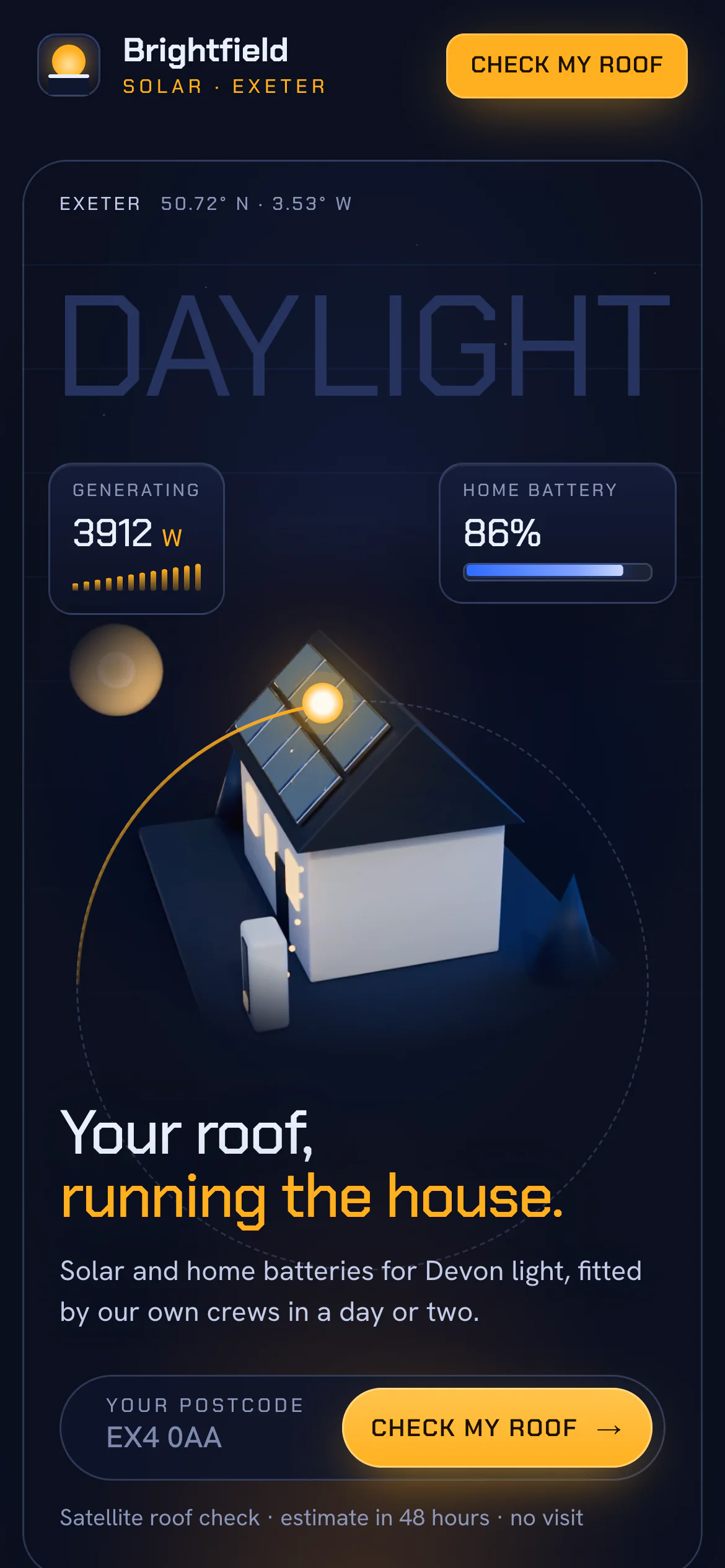
Brightfield opens like a product launch, not a lead-gen form. The whole first screen is a rounded dusk window. A Blender film of a house sits in the middle of it, and a giant, hair-thin DAYLIGHT stands behind the roof, with the film lightening over the letters so the house reads as standing in front of the word.
Also relevant: Voltway Electrical
51,060
electrical contractors registered across 377 UK local authorities.
Source: ONS UK Business Counts, SIC 43210, 2025. Open Government Licence v3.0.
| Local authority | Businesses |
|---|---|
| Buckinghamshire | 595 |
| Leeds | 590 |
| North Yorkshire | 530 |
| Cornwall | 510 |
| Birmingham | 455 |
| Somerset | 450 |
| Bromley | 385 |
| Wiltshire | 375 |
| Dorset | 370 |
| Havering | 365 |
£299to set up
£99a month
3working days to launch
You approve it before anything goes live.
Designed from scratch, every word written for you, hosting and Google setup included. Or pay £1,795 once and £49 a month with no minimum term.
Websites for electrical contractors that separate the domestic call-outs from the commercial contracts, because those two customers want completely different things.
What they need →Websites for roofing companies that handle both the leak-in-a-storm emergency and the twenty-thousand-pound re-roof, and make it obvious you are not a doorstep trader.
What they need →Websites for scaffolding companies, written for the roofer who needs a price by tomorrow and the homeowner who has never hired scaffolding and does not know what a licence is.
What they need →Websites for F-Gas certified air conditioning engineers, built for a trade that sells planned maintenance to businesses all year and then gets flooded by homeowners the moment a heatwave is forecast.
What they need →Websites for Gas Safe registered engineers that handle the no-heating call at seven in the morning, the landlord certificate booked months ahead, and the boiler replacement someone has been putting off for two winters.
What they need →Custom website design for UK businesses of any kind and any size, from sole traders to multi-site companies. £299 to set up, then £99 a month for design, copywriting, hosting and support - live in 3 working days.
Read more →Local SEO setup for small businesses - the technical foundations, Google Business Profile guidance and local relevance that get you found by nearby customers.
Read more →How Nerdsharks pricing works: a setup fee and a monthly plan, or pay for the build outright. What each covers, who should pick which, and the honest 12-month total.
Read →How ChatGPT decides which businesses to name, what it reads when it searches the web, and the practical steps that make yours easier to recommend.
Read →What Google’s AI Overviews and AI Mode are, how they choose sources, what they do to your clicks, and what a small business should actually change.
Read →£299 setup, then £99 a month. Live in 3 working days. Tell us what your business does - we reply the same working day.
Nerdsharks
A real person replies, usually the same working day
Hi 👋 What can we help with? Tap one, or type below.
Got it, thanks. We’ll reply the same working day - check your inbox or phone.