Websites for builders
Websites for building firms, built around finished-project photography - because an extension is bought with the eyes long before anyone reads a word.
What they need →Websites for architects
Websites for small architecture practices that show finished projects properly, explain fees and stages in plain English, and speak to homeowners as well as developers. From £99 a month, live in 3 working days.
Most small practices depend on residential clients - extensions, loft conversions, renovations, new homes - and those clients are usually doing this once. They search for "architect" plus a town, or for their project type, and they judge on photographs of finished work close to what they want and in their area. They are often unsure what an architect does compared with an architectural technician or a builder’s drawing service, what it costs, and how long planning takes, so the practice that explains the process honestly wins their confidence. Commercial and developer clients behave differently: they check sector experience, project scale, and whether you can take a scheme through planning. Many residential enquiries also arrive via builders, and they are checking that the practice looks serious.
When demand peaks. Residential enquiries rise in January and spring as people plan the year’s projects; they are sensitive to interest rates and the housing market.
Architecture websites are often designed to impress other architects rather than to help a homeowner: minimal navigation, cryptic project names, full-bleed images and very little text. A homeowner with a kitchen extension in mind cannot tell if the practice does projects their size, what happens first, or what fees look like. The fix is not to abandon good design but to add the explanation: projects grouped by type with location, budget band and what was solved; a clear page on how you work, stage by stage; and honest guidance on how fees are structured. The other gap is credentials - "architect" is a protected title in the UK and can only be used by people on the ARB register, which clients rarely know and practices rarely explain.
The standard first step for a residential project.
Lets the practice decide fit before a visit.
Comparable finished work is what persuades a client.
Trust signals we put on every page: ARB registration of named architects · RIBA Chartered Practice status or RIBA membership, where held · Finished projects with locations · Professional indemnity insurance · Planning approvals achieved, described factually
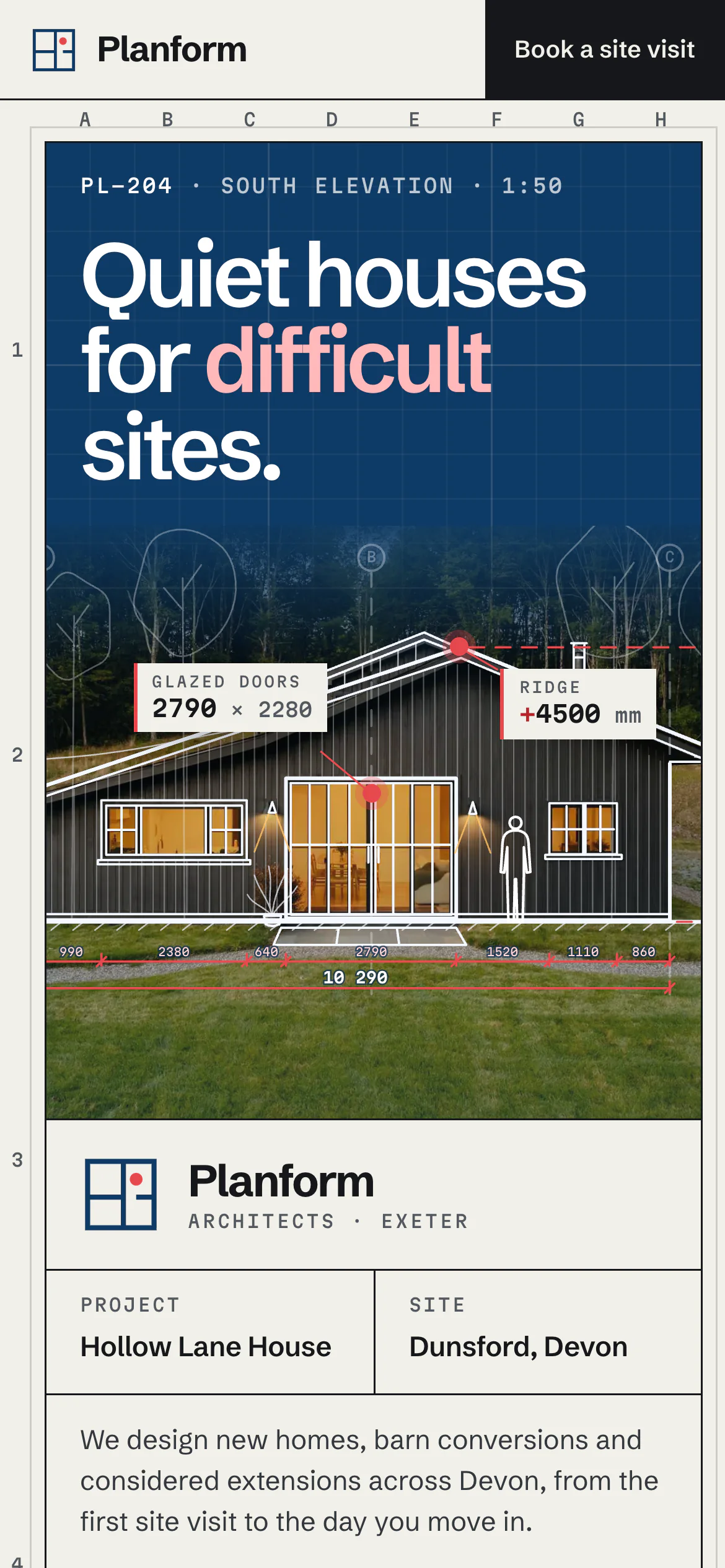
An architect’s real product is the drawing, so the whole first screen is a drawing sheet: grid references in the margin, a blueprint field, and a proper title block down the right-hand edge carrying the practice, the project, the scale, the drawing number, the revision and the call to book a site visit. In the field, a south elevation of a finished house draws itself line by line: grid, ground, walls, roof, glazing, cladding, a figure for scale, then the dimension strings. The photograph of the built house then fades up behind the linework and the measurement callouts tick into place, so the visitor watches drawing become building in five seconds.
Also relevant: Halewood Build
14,480
architecture practices registered across 372 UK local authorities.
Source: ONS UK Business Counts, SIC 71111, 2025. Open Government Licence v3.0.
| Local authority | Businesses |
|---|---|
| Hackney | 370 |
| Camden | 330 |
| Islington | 300 |
| Westminster | 295 |
| Southwark | 265 |
| Lambeth | 170 |
| City of Edinburgh | 165 |
| Birmingham | 155 |
| Kensington and Chelsea | 155 |
| Wandsworth | 155 |
£299to set up
£99a month
3working days to launch
You approve it before anything goes live.
Designed from scratch, every word written for you, hosting and Google setup included. Or pay £1,795 once and £49 a month with no minimum term.
Websites for building firms, built around finished-project photography - because an extension is bought with the eyes long before anyone reads a word.
What they need →Websites for interior designers that show finished rooms properly, explain how you charge, and make it clear whether you design a single room or run a whole renovation.
What they need →Websites for loft conversion specialists, built for a homeowner who will research for months, worry about planning and party walls, and choose the firm that made the whole thing feel understandable.
What they need →Websites for kitchen fitters, built around the fact that most customers have already chosen their units and are now choosing the person they trust to fit them without wrecking the house.
What they need →Websites for estate and letting agents, built for the audience that actually pays the bills: the vendor deciding who to instruct.
What they need →Custom website design for UK businesses of any kind and any size, from sole traders to multi-site companies. £299 to set up, then £99 a month for design, copywriting, hosting and support - live in 3 working days.
Read more →Website redesign for small businesses with an existing site that is slow, dated, or not producing enquiries, with your existing content and rankings carried across properly. From £99 a month.
Read more →How Nerdsharks pricing works: a setup fee and a monthly plan, or pay for the build outright. What each covers, who should pick which, and the honest 12-month total.
Read →How ChatGPT decides which businesses to name, what it reads when it searches the web, and the practical steps that make yours easier to recommend.
Read →What Google’s AI Overviews and AI Mode are, how they choose sources, what they do to your clicks, and what a small business should actually change.
Read →£299 setup, then £99 a month. Live in 3 working days. Tell us what your business does - we reply the same working day.
Nerdsharks
A real person replies, usually the same working day
Hi 👋 What can we help with? Tap one, or type below.
Got it, thanks. We’ll reply the same working day - check your inbox or phone.