Websites for barbers
Websites for barbershops built to do three things fast: show the cuts, show the prices, and let someone book without ringing.
What they need →Websites for tattoo studios
Websites for tattoo studios built around the artists: individual portfolios, clear booking and deposit rules, and the licensing and age policy that serious clients look for. From £99 a month, live in 3 working days.
People choose a tattoo artist, not a studio. They have usually been planning the piece for months, they know the style they want - fine line, blackwork, realism, traditional, Japanese - and they search for an artist who does that style well. They scroll a whole portfolio looking for healed work, not just fresh photos under a ring light, and for pieces similar in size and placement to theirs. Once they find the right artist they will travel and wait months. The practical questions come after: how to book, how much the deposit is, whether the artist does their own designs from a brief, day rates versus hourly, and whether the studio takes walk-ins for flash. First-timers add a layer of nerves and want to know about pain, aftercare, hygiene and what to expect on the day.
When demand peaks. Spring and early summer are busiest as people plan pieces before showing skin. Many artists open their books on set dates, which creates their own short peaks.
Tattoo studios rely almost entirely on each artist's Instagram, which works until an account is suspended or an artist leaves and takes the whole audience with them. The studio site, where it exists, is usually a dark page with a logo, a phone number and a stock photo of a tattoo gun. It does not let a client find the right artist by style, it does not explain the booking process, and it does not show the studio is registered with the council. A good studio site gives each artist a page with their style, healed work and their own booking form, sets out deposits and cancellation terms clearly, and states the over-18 rule and ID policy plainly - which also saves the front desk a lot of awkward conversations.
The client has chosen a person; the form should route straight to them with the brief attached.
Custom design time is wasted without a deposit, and it cuts no-shows.
Fills gaps between custom bookings and brings in first-timers.
Trust signals we put on every page: Local-authority registration or licence for tattooing and skin piercing (premises and individual artists) · Healed-work photography per artist · Hygiene and infection control standards · Written aftercare guidance · Age verification and ID policy
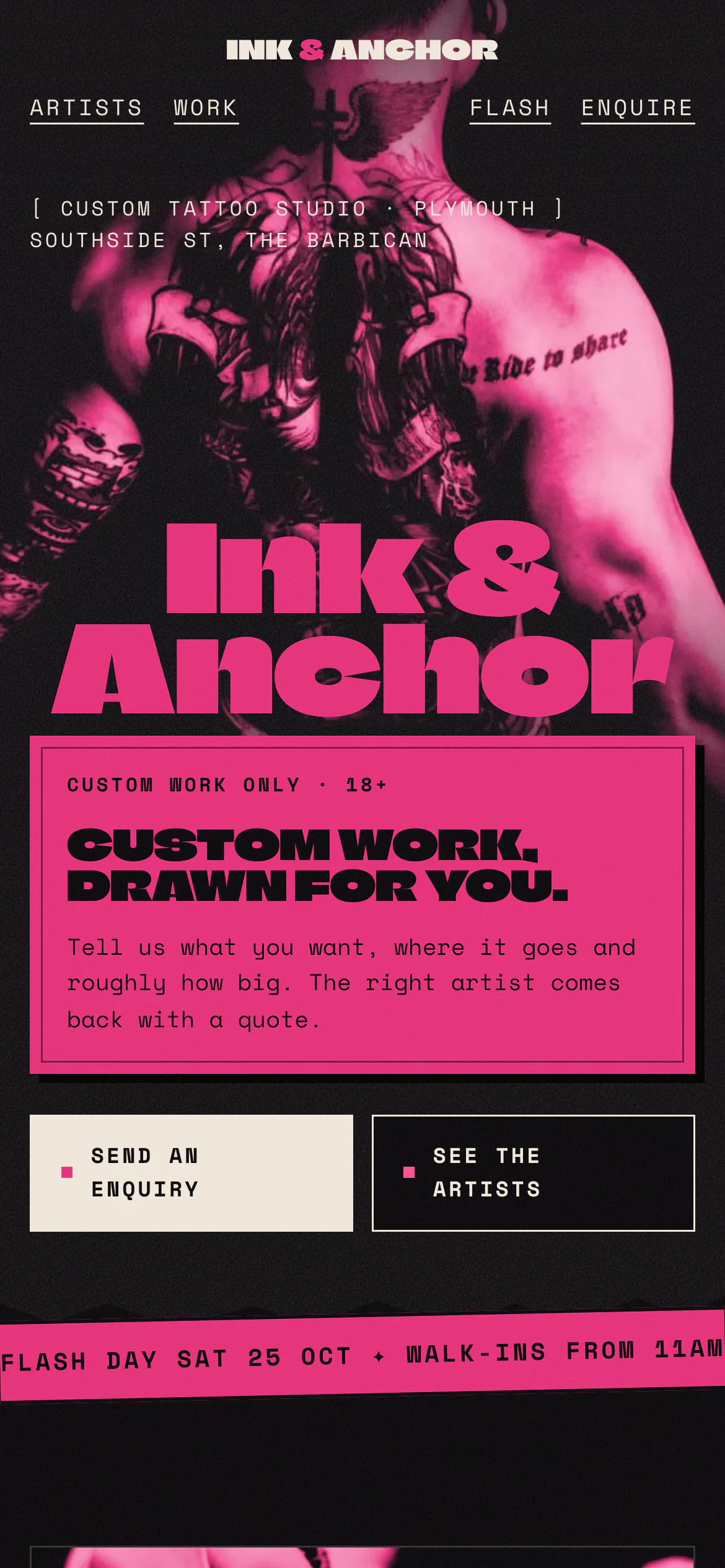
Tattoo clients choose an artist and a style, not a studio, so the page opens like a gig poster pasted on a wall. A pink-toned photograph of a tattooed back stands in front of a giant "Ink & Anchor" wordmark, so the lettering disappears behind the shoulders and returns either side. On load the wordmark bleeds in: eroded, half-melted letters come first, then solid ink glitches in over them in stepped bands while a misregistered bone-white copy snaps into place.
24,310
other personal service businesses, a category that includes pet grooming, pet boarding and tattooing registered across 377 UK local authorities.
Source: ONS UK Business Counts, SIC 96090, 2025. Open Government Licence v3.0.
| Local authority | Businesses |
|---|---|
| Westminster | 475 |
| Buckinghamshire | 355 |
| Camden | 315 |
| Birmingham | 280 |
| North Yorkshire | 255 |
| Islington | 250 |
| Cheshire East | 235 |
| Wiltshire | 220 |
| Leeds | 210 |
| West Northamptonshire | 210 |
£299to set up
£99a month
3working days to launch
You approve it before anything goes live.
Designed from scratch, every word written for you, hosting and Google setup included. Or pay £1,795 once and £49 a month with no minimum term.
Websites for barbershops built to do three things fast: show the cuts, show the prices, and let someone book without ringing.
What they need →Websites for nail technicians and nail bars that show off the actual sets, price the extras honestly, and take bookings without the constant DM back-and-forth.
What they need →Websites for beauty salons and aesthetic clinics that handle long treatment menus without turning into an unreadable price list.
What they need →Websites for photographers where the site has to disappear behind the work - and load fast while carrying a hundred large images.
What they need →Custom website design for UK businesses of any kind and any size, from sole traders to multi-site companies. £299 to set up, then £99 a month for design, copywriting, hosting and support - live in 3 working days.
Read more →Local SEO setup for small businesses - the technical foundations, Google Business Profile guidance and local relevance that get you found by nearby customers.
Read more →How Nerdsharks pricing works: a setup fee and a monthly plan, or pay for the build outright. What each covers, who should pick which, and the honest 12-month total.
Read →How ChatGPT decides which businesses to name, what it reads when it searches the web, and the practical steps that make yours easier to recommend.
Read →What Google’s AI Overviews and AI Mode are, how they choose sources, what they do to your clicks, and what a small business should actually change.
Read →£299 setup, then £99 a month. Live in 3 working days. Tell us what your business does - we reply the same working day.
Nerdsharks
A real person replies, usually the same working day
Hi 👋 What can we help with? Tap one, or type below.
Got it, thanks. We’ll reply the same working day - check your inbox or phone.