Websites for bathroom fitters
Websites for bathroom fitters, built for a customer who has been saving pictures for a year and now has to trust someone to rip out the only toilet in the house.
What they need →Websites for tilers
Websites for wall and floor tilers, built for customers who judge the work by grout lines, cuts and levels - and who usually found the tiles long before they found you. From £99 a month, live in 3 working days.
Most tiling customers have already spent hours in a tile showroom or online choosing tiles before they look for someone to lay them, and they are anxious about how an expensive choice will look once it is on the wall. Many are sent your way by the tile shop, which often keeps a list of local fitters, so your site is checked as a second opinion. Others arrive through bathroom and kitchen fitters who subcontract the tiling. Homeowners compare tilers on photos of very specific things: large-format porcelain laid flat without lipping, herringbone that finishes cleanly at a doorway, neat cuts around a toilet pan, mitred corners instead of plastic trim. They often think about price per square metre, because that is how they bought the tiles, and want a rough figure before inviting you round. Wet rooms and underfloor heating push them towards someone who can explain the preparation, not just the finish.
When demand peaks. Tiling follows the bathroom and kitchen calendar: busy from January into spring and again in the autumn run-up to Christmas. Being indoor work, it fills the winter weeks that outdoor trades lose.
A tiling website usually shows wide shots of finished bathrooms that could be anyone’s work - the bathroom fitter probably has the same room in their gallery. What sells a tiler is the close-up: tight grout lines, the cut around the soil pipe, a straight edge across a large-format floor. Sites also say nothing about preparation - tanking, levelling, backer boards - which is where tiling jobs actually fail and exactly what the customer who has read horror stories wants to hear about. And almost nobody gives even a rough price per square metre, in a trade where customers already think in those terms.
Tile size and layout change the price more than anything, so ask for them up front.
Shops and bathroom fitters send steady work to tilers they trust.
Higher-value jobs where preparation knowledge is the reason to choose you.
Trust signals we put on every page: Close-up photography of cuts and grout lines · The Tile Association membership where held · Tanking system manufacturer approvals where held · Public liability insurance · Referrals from local tile showrooms
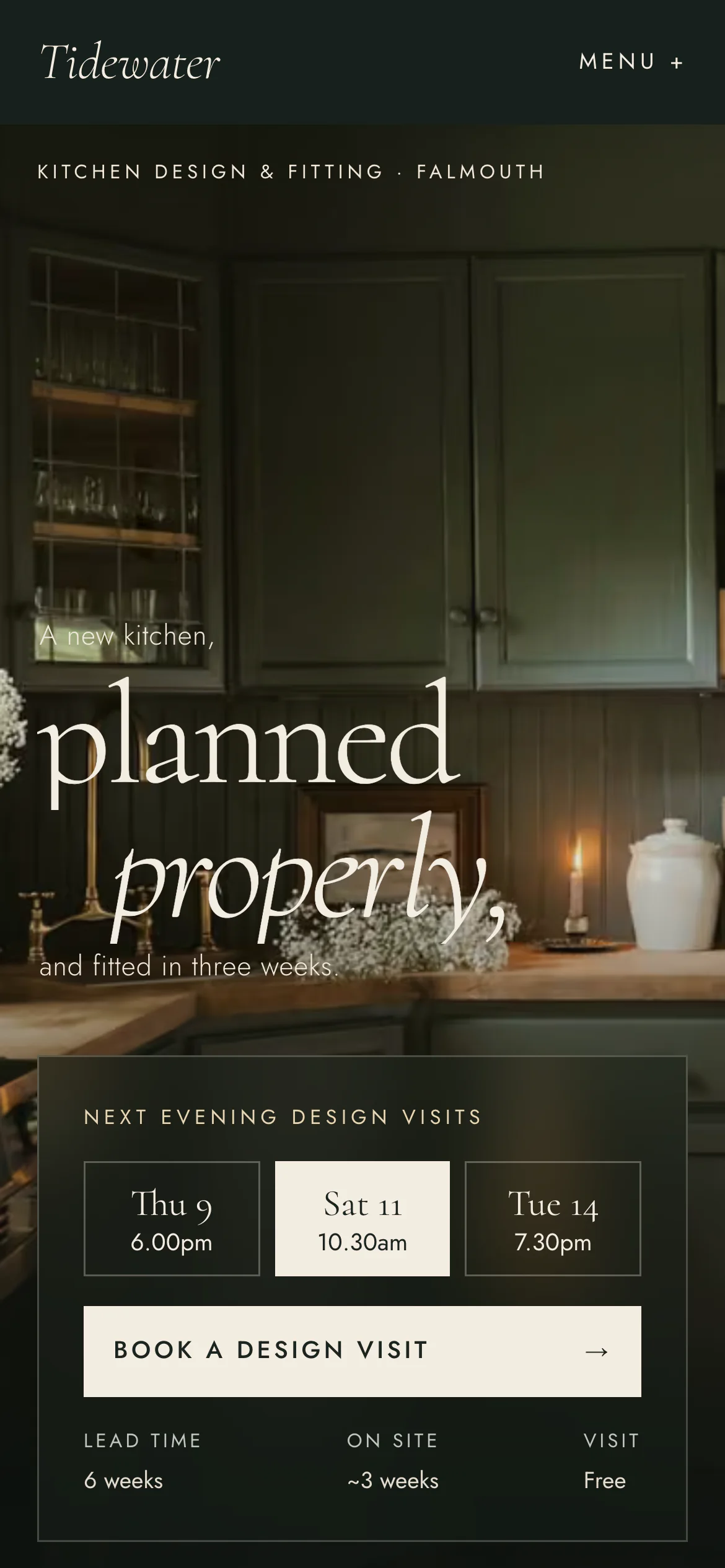
Kitchen buyers spend months deciding and come back to browse, so Tidewater reads like a slow interiors magazine with a showroom's sense of touch. A dark vertical rail on the left holds the wordmark, a numbered contents list with a progress line that fills as you read, and the phone number, leaving the page to the photographs. The hero is cinematic: a moody green kitchen full bleed, 'planned properly' set huge in light Cormorant italic across it, and a frosted card offering the next three evening design visits.
Also relevant: True Level Plastering & Rendering
9,710
floor and wall covering businesses registered across 373 UK local authorities.
Source: ONS UK Business Counts, SIC 43330, 2025. Open Government Licence v3.0.
| Local authority | Businesses |
|---|---|
| Somerset | 115 |
| Leeds | 110 |
| Birmingham | 105 |
| Buckinghamshire | 105 |
| Havering | 90 |
| South Gloucestershire | 85 |
| Dorset | 85 |
| West Northamptonshire | 80 |
| Wiltshire | 80 |
| Medway | 75 |
£299to set up
£99a month
3working days to launch
You approve it before anything goes live.
Designed from scratch, every word written for you, hosting and Google setup included. Or pay £1,795 once and £49 a month with no minimum term.
Websites for bathroom fitters, built for a customer who has been saving pictures for a year and now has to trust someone to rip out the only toilet in the house.
What they need →Websites for kitchen fitters, built around the fact that most customers have already chosen their units and are now choosing the person they trust to fit them without wrecking the house.
What they need →Websites for flooring and carpet fitters that make sense of a confusing purchase - LVT, laminate, engineered wood, carpet - and make it obvious you fit what customers bought elsewhere.
What they need →Websites for plasterers and renderers, built for a trade whose best work is a perfectly flat wall - the hardest thing in the world to photograph and the easiest to undersell.
What they need →Websites for plumbing and heating businesses, built around the one thing that matters when a pipe bursts: getting the phone to ring in under a minute.
What they need →Custom website design for UK businesses of any kind and any size, from sole traders to multi-site companies. £299 to set up, then £99 a month for design, copywriting, hosting and support - live in 3 working days.
Read more →Local SEO setup for small businesses - the technical foundations, Google Business Profile guidance and local relevance that get you found by nearby customers.
Read more →How Nerdsharks pricing works: a setup fee and a monthly plan, or pay for the build outright. What each covers, who should pick which, and the honest 12-month total.
Read →How ChatGPT decides which businesses to name, what it reads when it searches the web, and the practical steps that make yours easier to recommend.
Read →What Google’s AI Overviews and AI Mode are, how they choose sources, what they do to your clicks, and what a small business should actually change.
Read →£299 setup, then £99 a month. Live in 3 working days. Tell us what your business does - we reply the same working day.
Nerdsharks
A real person replies, usually the same working day
Hi 👋 What can we help with? Tap one, or type below.
Got it, thanks. We’ll reply the same working day - check your inbox or phone.