Websites for clinics & private healthcare
Websites for private clinics - physiotherapy, podiatry, osteopathy and allied health - where the visitor usually has a specific problem and wants to know if you fix it.
What they need →Websites for physiotherapists
Websites for private physiotherapists that are found by the injury people type into Google, show HCPC registration up front, and make booking an assessment this week easy. From £99 a month, live in 3 working days.
A private physio patient is usually in pain, often fed up with a wait, and searching by the problem rather than the profession: knee pain after running, a shoulder that will not lift, back pain that has lasted a month. They want to know whether you treat that, how soon they can be seen, what a first assessment costs and how many sessions it tends to take. Many are self-funding; others are using private health insurance and need to know whether you are recognised by their insurer. They check that the physio is genuinely a physiotherapist - the title is protected and HCPC registration is checkable - and they look for specialisms that match them, such as sports injuries, women's health, post-surgery rehab or neurological physio. Location, parking and evening appointments decide the final choice between two similar clinics.
When demand peaks. January brings back pain and new-year exercise injuries; spring marathon training and the football season produce sports injury peaks.
Physio websites are usually written for other physios: a list of techniques - dry needling, manual therapy, soft tissue mobilisation - that means nothing to a patient with a sore Achilles. The patient needs condition pages in plain language, a clear first-appointment price, and the next available slot. The second trap is claims. Healthcare advertising is covered by the CAP Code, and promising outcomes or recovery times is both risky and unconvincing. The third is failing to say which insurers recognise you, which sends insured patients to a clinic that does say. Plain, specific, careful copy wins here.
The entry point to a course of treatment and the decision the whole site is working towards.
Patients search by symptom, and each condition page is a doorway to a booking.
Insured patients have a funding route already and convert readily when recognition is clear.
Trust signals we put on every page: HCPC registration for each physiotherapist · Chartered Society of Physiotherapy membership · Recognition by private medical insurers where genuine · Specialist post-graduate training · Published session prices
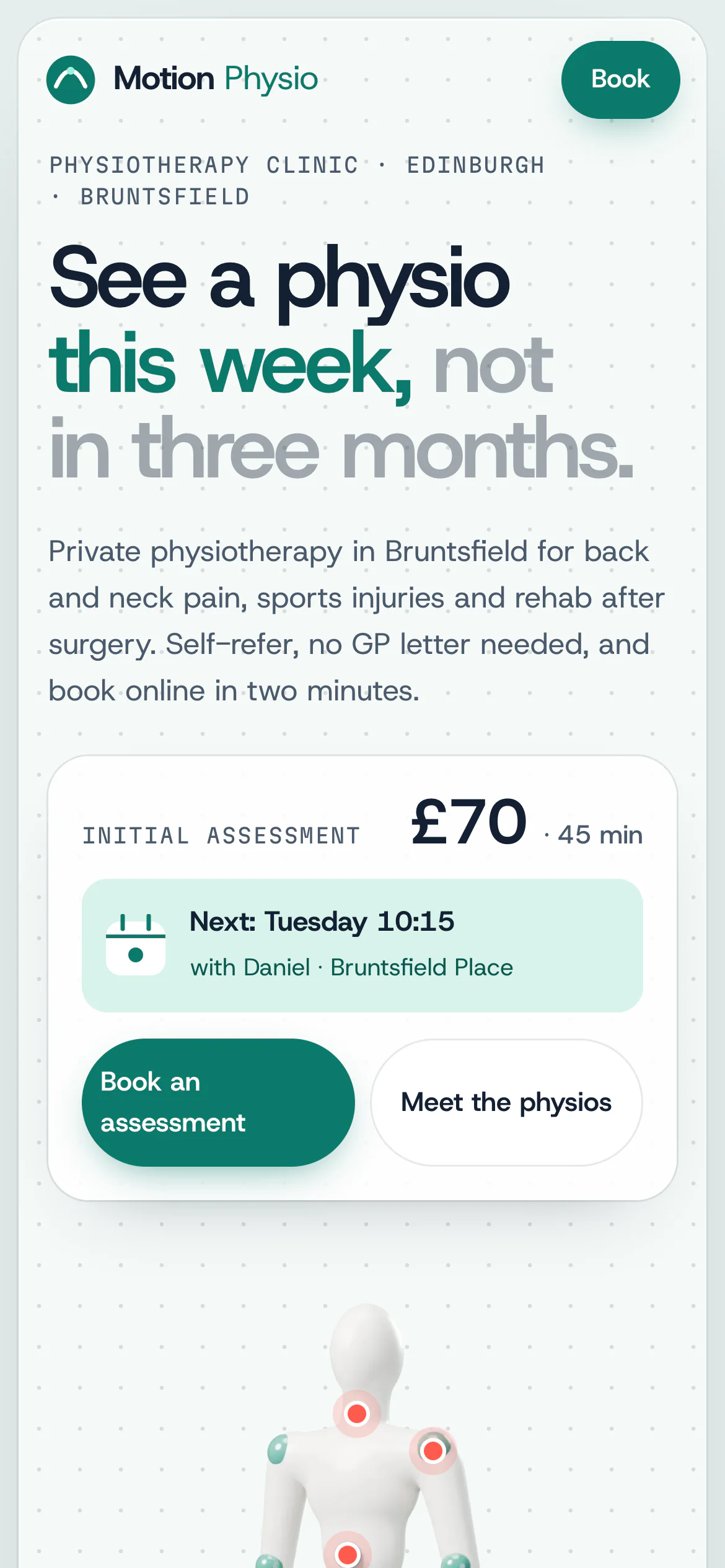
Most patients come here after a long NHS wait, want to be seen quickly, and need to know the cost and whether their insurer is accepted. The whole first screen is a clinic app window on a soft dot grid. In the middle stands a 3D mannequin made in Blender, in ivory ceramic with teal ball joints, and red pain hotspots pulse on its neck, shoulder, lower back, hip, knee and Achilles.
27,165
other health practices registered across 376 UK local authorities.
Source: ONS UK Business Counts, SIC 86900, 2025. Open Government Licence v3.0.
| Local authority | Businesses |
|---|---|
| Birmingham | 720 |
| Westminster | 435 |
| Leeds | 395 |
| Manchester | 360 |
| Camden | 345 |
| Bradford | 330 |
| Kirklees | 330 |
| Barnet | 300 |
| Buckinghamshire | 270 |
| Hackney | 255 |
£299to set up
£99a month
3working days to launch
You approve it before anything goes live.
Designed from scratch, every word written for you, hosting and Google setup included. Or pay £1,795 once and £49 a month with no minimum term.
Websites for private clinics - physiotherapy, podiatry, osteopathy and allied health - where the visitor usually has a specific problem and wants to know if you fix it.
What they need →Websites for chiropractors that are clear about what a first visit involves, show GCC registration properly, and are written carefully within the advertising rules on health claims.
What they need →Websites for massage therapists - sports, deep tissue and relaxation - that explain each treatment in plain words, show qualifications, and keep well inside the rules on health claims.
What they need →Websites for personal trainers that make clear who you train, what it costs and how to start - and turn a follower into a paying client without a week of DMs.
What they need →Websites for gyms and studios where the real job is answering "would I feel out of place here" before anyone gets near a membership price.
What they need →Custom website design for UK businesses of any kind and any size, from sole traders to multi-site companies. £299 to set up, then £99 a month for design, copywriting, hosting and support - live in 3 working days.
Read more →Local SEO setup for small businesses - the technical foundations, Google Business Profile guidance and local relevance that get you found by nearby customers.
Read more →How Nerdsharks pricing works: a setup fee and a monthly plan, or pay for the build outright. What each covers, who should pick which, and the honest 12-month total.
Read →How ChatGPT decides which businesses to name, what it reads when it searches the web, and the practical steps that make yours easier to recommend.
Read →What Google’s AI Overviews and AI Mode are, how they choose sources, what they do to your clicks, and what a small business should actually change.
Read →£299 setup, then £99 a month. Live in 3 working days. Tell us what your business does - we reply the same working day.
Nerdsharks
A real person replies, usually the same working day
Hi 👋 What can we help with? Tap one, or type below.
Got it, thanks. We’ll reply the same working day - check your inbox or phone.